Augmented reality mental health crisis training app developed
- 8 July 2025


- Tees, Esk and Wear Valleys NHS Foundation Trust and Teesside University have co-developed an augmented reality (AR) mental health crisis simulation training app
- The app, which the trust says is the first of its kind in England, is designed to teach student nurses what it is like to help someone who may be experiencing a mental health crisis
- It has been piloted within the trust’s nursing education team with hopes of it being rolled out across the country
Tees, Esk and Wear Valleys NHS Foundation Trust and Teesside University have co-developed an augmented reality (AR) mental health crisis simulation training app.
The app, which the trust says is the first of its kind in England, is designed to teach student nurses what it is like to help someone experiencing a mental health crisis.
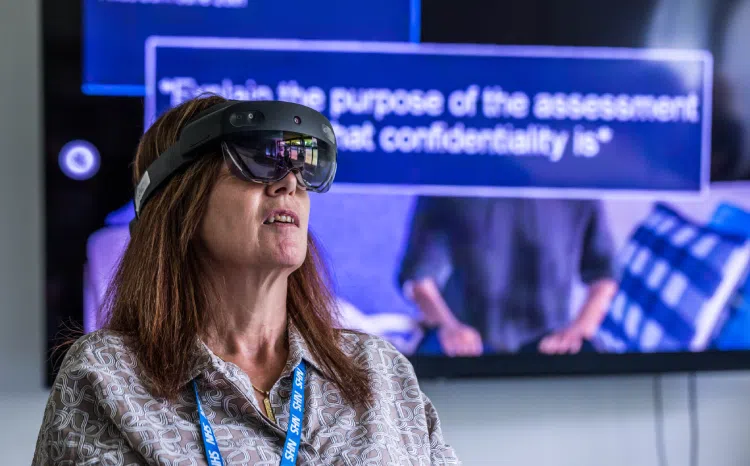
It is used alongside an AR headset to simulate a crisis assessment whereby ‘Paul’ has been referred to his local crisis team for his mental health needs and concerns.
Jools Smithies, a senior nurse practice placement facilitator, said: “In the scenario, students visit Paul’s home and must make decisions when interacting with him through pre-populated questions that result in different answers and support Paul whilst he is distressed.
“The AR pauses at various points within the simulation to allow the students to discuss their thoughts with a supervisor and to motivate them to consider other things such as safeguarding, if they haven’t already.
“This new innovative training will build student nurses’ confidence as well as communication, signposting and decision-making skills in crisis assessment that will be transferable in the real world.
“The results from our initial pilot showed a 51% increase in knowledge and 63% increase in confidence from our student nurses.”
The headset was initially trailed in September 2023, before the trust purchased two HoloLens headsets in 2024 to trial the mental health app.
Tucan Studio, based at Teesside University, developed the app with trust staff, bringing their knowledge of mental health and assessment skills to create its content and script, which was voiced by a Teesside actor.
The AR app is part of the NHS-led Placement, Expansion, Technology, augmented, Reality (PETaR) project, which aims to use AR headsets in a variety of settings including medical, surgical and community in NHS trusts across the north east.
Abigail Green, associate professor in clinical simulation at Teesside University, said: “From the perspective of sending our students to a simulated placement it gives them an opportunity to practice and rehearse scenarios that they wouldn’t necessarily be allowed to do independently without supervision.
“It gives them the opportunity to experience that before they’re expected to be qualified and go out and do it themselves.
“Speaking with some of our students about their experience using the AR headset, they have also been able to see things from a patient’s perspective.
“This is something you wouldn’t be able to see unless you do something like using the mental health AR app where you are put in the shoes of the patient.”
The project has received funding from the Enabling Effective Learning Environment team in the NHS North East and North Cumbria Integrated Care System.
It has been piloted within the trust’s nursing education team with hope of being rolled out across the country.
Meanwhile, in March 2025, digital therapeutic software firm Strolll secured £10.35m for it AR glasses to help people living with neurological disorders such as Parkinson’s disease, stroke and multiple sclerosis.